Prime Cost: Definition, Formula & Calculation
Updated on February 24, 2023 | 4 min. read


🌟 KEY TAKEAWAYS

A prime cost is the total direct cost that is associated with production.
This includes labor and raw materials.u0026nbsp;
Indirect costs are not included in prime costs. This is costs such as manager salaries, delivery costs, and utilities.u0026nbsp;
It’s important to calculate the prime cost of each product to make sure that they are making a profit.
But what type of cost is prime cost? And how can you use it to make sure your business is making a decent profit? Read on and find out.
What Is a Prime Cost?
A prime cost is a company expense that is directly related to the labor and materials that are used in the production process. It is the total cost of production. Essentially, a prime cost refers to the cost of a manufactured product. These are calculated to make sure that the company is experiencing the best profit margins possible.
The prime cost calculates the direct costs of the raw materials that are used when producing a good. It also takes labor into account. Direct costs only include what is known as a direct expense. They don’t include any indirect expenses, such as administrative costs and advertising.


Why Is the Prime Cost Important?
Prime cost takes into consideration all of the total direct costs associated with a good or service. Businesses can use prime cost as a way of calculating the total cost of production inputs that are needed in order to create the desired output.
By analyzing the price costs of a company, it can increase its profits. They can also use the information to undercut the competitors’ prices.
For companies that sell more than one product or service, the prime cost of each product would need to be calculated. This is in order to ensure that they are in fact making an overall profit.
For self-employed individuals, the prime cost calculation can be used to make sure they are making a desired hourly wage. Whilst also ensuring that they are making a profit with each sale.
Indirect costs are not factored into the prime costs. Indirect costs include things such as utilities, salaries, and delivery costs. They are not included in prime costs for a number of reasons. One reason is that they can be difficult to allocate and quantify.
What Is the Prime Cost Formula?
The prime cost equation that is used to calculate the prime cost is very straightforward. It is as follows:
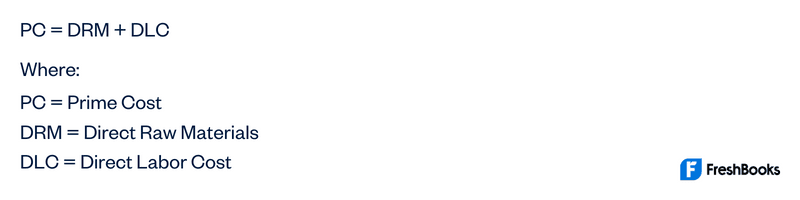
In order to find the total costs for direct raw materials, you just need to find them on the company’s balance sheet. The same can be said for finding the direct labor cost, which can also be found on the company’s balance sheet.


What Is an Example of Using the Prime Cost Method?
Let’s say that a professional baker is hired to make a multi-tier wedding cake for a customer. The prime costs for creating the cake include the raw materials and the direct labor cost of making the cake. There are numerous expenses that can be associated with making a cake. But common raw materials for the direct material cost would include:
- Eggs
- Flour
- Butter
- Icing
- Sugar
Let’s say that it is a large cake with expensive ingredients that total a flat cost of $100. The baker charges $50 per hour for their labor, and it takes a total of six hours to make the cake. Using this information, we can use the prime cost formula to calculate the prime cost to produce the cake.
PC = 100 + (50 x 6)
PC = 400
So as you can see, the prime cost to produce the cake amounts to $400. In order for the baker to make a profit on this cake, then they would need to set the price of the cake above its prime cost.
Now let’s say that the baker sold this cake for a minimum sales price $450. If you just take the raw materials into account, then they would have made a profit of $50. Now let’s say that they only charged $10 per hour to make the cake, then they would have ended up making a loss of $10.
This is why it’s important for self-employed workers to take prime cost into consideration when determining what price to set for their goods or services. So if the baker wanted to make sure they are paid $50 per hour for making the cake and make at least $50 profit, then they would need to take that into consideration of the cost per unit.
Summary
Being able to calculate the prime cost is important for both businesses as well as freelance or self-employed workers. However, prime costs only consider the direct cost. This means that it doesn’t capture the entire production process cost. This can mean that the prime cost calculation can be misleading if the indirect production costs incurred are somewhat large.


FAQs on Prime Cost