

Yield on Cost (YOC): Definition, Advantages & Disadvantages
Updated on January 6, 2026 | 3 min. read


🌟 KEY TAKEAWAYS

YOC is a calculation of dividend yield depending on the investment's initial share price.
Investing for dividend growth is the best approach for long-term investors to maximize YOC because it can increase dramatically over time if the firm consistently raises its dividend.
Investors utilizing YOC should be careful to avoid making unbalanced comparisons between it and the dividend yields of other equities.
So, if you are searching for an effective strategy then you have come to the right place. We put together this guide to break down everything you need to know about yield on cost. Keep reading to learn more.
What Is Yield on Cost (YOC)?
Yield on cost (YOC) is a method of calculating dividend yield that involves subtracting the current payout from the cost of a stock. The YOC for a stock, for instance, would be 7.5% if a purchaser bought it for $200 five years ago and the current dividend is $15 per share.
Contrary to popular belief, YOC is not the same as the current dividend yield. In contrast to the initial purchase price, the later calculation uses the dividend payout divided by the stock's current stock price.
Investors use yield on cost, also known as development yield, as a benchmark to evaluate a project based on its cost and possible return.


How Is Yield on Cost Calculated?
The original cost of a security is used to compute YOC. The holding costs for that asset over time, as well as any additional share acquisitions, must therefore be recorded by investors. All of these expenses need to be factored into the YOC calculation's cost component. If not, the yield will seem excessively high.
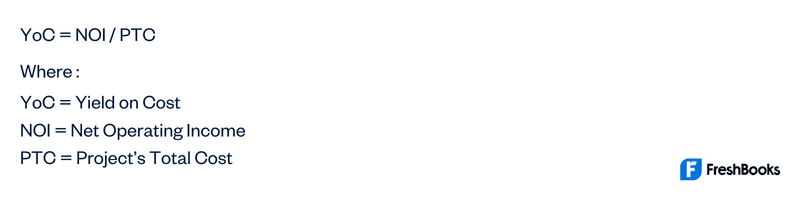
When you’re looking to calculate the yield on cost, simply divide the net operating income by the project's total cost.
This can be shown via the following yield on cost formula:
What Are the Advantages of Yield on Cost?
When determining how effective a current investment has been in generating money in the past, the yield on cost might be helpful. Yield on cost is a means of calculating how much money you are getting in relation to your initial investment.
Another simple way to assess the dividend growth of stock investments in the past is to look at yield on cost.


What Are the Disadvantages of Yield on Cost?
The yield on cost indicator has detractors who claim it is a retrospective measure that ignores relative dividend payments in the present environment. Another potential downside is that it may obscure the effects of unfavorable company events, such as a dividend cut.
Example of Yield on Cost
Let’s say that an investor put $10,000 into Company X and purchased shares at a current price of $7.30 per share. Company X paid dividends to its stockholders of $0.156 per year. This results in an initial yield on cost of 2.14%
This yield on cost would mean that the annual dividends would result in an income of roughly $213.70 on the original investment.
Summary
One of the most common indicators used by dividend investors is yield on cost. Although an increasing return on cost may indicate a successful dividend growth plan, the indicator alone is not very helpful when choosing incremental investments.
Instead, we must assess a company's fundamentals to ensure that its dividend safety and growth profile remain consistent with our investing goals.


FAQS About Yield on Cost