Yield to Maturity: Definition, Formula, Pros & Cons
Updated on January 6, 2026 | 4 min. read


🌟 KEY TAKEAWAYS

Yield to maturity (YTM) is the overall rate of return that a bond will have earned once all interest payments are made and the principal is repaid.
In essence, YTM represents the internal rate of return (IRR) on a bond if held to maturity.
It might be difficult to calculate yield to maturity since it relies on the assumption that every coupon rate or interest payment can be reinvested at the bond's rate of return.
Is there a way to do this? The answer is yes, and you can do it by calculating the yield to maturity. Continue reading to learn everything you need to know, including the formula, the advantages, the disadvantages, and more!
What Is Yield To Maturity?
Yield to maturity (YTM) is the complete return expected on a bond if it is held until maturity. Although it is expressed as an annual rate, yield to maturity is regarded as a long-term bond yield. It is, therefore, the internal rate of return (IRR) of a bond investment assuming the investor retains the bond until maturity, with all scheduled payments made and reinvested at the same pace.
Book yield and redemption yield are other names for yield to maturity.


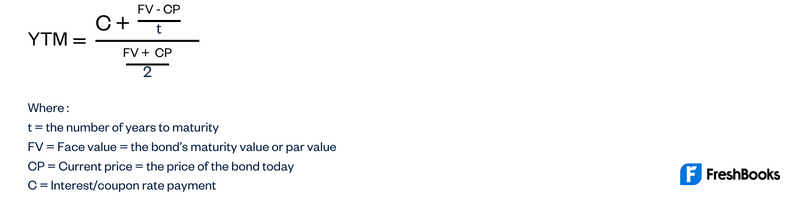
Formula to Calculate Yield To Maturity
The formula that is used to calculate yield to maturity is as follows:
Why Is Yield To Maturity Calculated?
The present value of all future cash flows matches the bond's market price because YTM is the interest rate that an investor would receive if reinvested each bond coupon rate payment at a constant interest rate until the bond's maturity date. Investors are aware of the bond's current price, coupon rate payments, and maturity amount, but they are unable to directly determine the discount bond rate.
When determining YTM on a bond that is trading below par, a bond investor would solve the equation by substituting other annual interest rates that are greater than the coupon rate until they reached a current bond price that was reasonably near to the price of the bond in question.
Yield to maturity (YTM) calculations consider the bond's current market price, par value, coupon interest rate, and term to maturity as well as the assumption that all coupon payments will be reinvested at the same rate as the bond's current yield. Given that coupon payments are not always reinvested at the same interest rate, the yield to maturity (YTM) is only a snapshot of the return on a bond. The YTM will grow as interest rates rise and fall as interest rates decline.
What Are the Advantages of Yield to Maturity?
The advantages of yield to maturity are as follows:
- It calculates the total return that a bondholder will get over the course of the bond's life.
- It takes into account capital gains in addition to revenue gains to provide a full picture of earnings.
- It provides more accurate information because it does not involve a forecast in its calculation.
The main benefit of YTM is that it accounts for all future and initial cash flows, including capital as well as revenue-related cash flows.
What Are the Disadvantages of Yield to Maturity?
The disadvantages of yield to maturity are as follows:
- It presupposes that the bond or investment will be held until maturity. This is unrealistic given the diversity of basic bonds that allow investors to square up their bets before maturity. As well as the possibility that a skilled investor may exercise that option.
- The rate of investment is a significant additional constraint on yield to maturity. Yield to maturity is calculated based on the supposition that all investment profits would be reinvested uniformly. In today's market, investors have a variety of possibilities, and a savvy investor will never invest at the same rate if a better one is available.
It is virtually wrong to assume that the rate of return on investment will remain constant during the course of the investment.
What Is a Bond’s Yield to Maturity (YTM)?
The internal rate of return (IRR) associated with purchasing and keeping a bond until its maturity date is known as the YTM of a bond. In other words, it represents the profit made from purchasing the bond and reinvested coupon payments at a fixed interest rate. If all else is equal, a bond's YTM will be higher if its purchase price is lower and vice versa.
Example of Yield to Maturity
Let's look at an example to better comprehend the YTM formula and how it functions.
Assume that a bond with a $500 face value is available on the market and is priced at $425. The annual coupons on this bond are $75. The bond's coupon rate is 15%, and its maturity date is 7 years away.
The following is the simple formula for calculating an approximation of YTM:

Summary
The discount rate at which the total future cash flows resulting from an investment in the bond would equal par value is known as yield to maturity. It is a helpful metric to utilize when assessing bond investment proposals.
However, yield to maturity is an often complex process. It is frequently challenging to determine an accurate YTM value since yield to maturity determination is a complicated process. Instead, one can get a rough idea of YTM by using a yield to maturity calculator, yield table, or financial calculator.


FAQS on Yield to Maturity