Expected Loss Ratio (ELR) Method: Definition & Formula
Updated on February 20, 2023 | 4 min. read


🌟 KEY TAKEAWAYS

ELR method is a statistical tool used to predict the probability of an event occurring.
ELR method uses historical data to calculate the likelihood of an event happening again in the future.
This information can be useful for making decisions about things like insurance premiums and future claims.
But how exactly do insurance companies figure all of this out? Oftentimes, the expected loss ratio method comes into play. Keep reading to learn more, including the formula, how it works, and some of its limitations.
What Is Expected Loss Ratio – ELR Method?
Expected Loss Ratio (ELR) method is a statistical tool used to predict the probability of an event occurring. It is a specific way of calculating the cost of insurance.
The idea behind ELR is that you look at the expected losses for a certain policy or set of policies. And based on those expected results, you can work out how much it will cost to pay for those losses.
That’s why ELR is also called the expected loss ratio method of calculating the cost of insurance. ELR is a way of assessing the cost of premiums based on how much it costs the insurer to pay out on a claim.
It’s a very specific method of measuring the expense that the insurer has as a result of issuing policies. ELR is simply the expected number of claims against a policy divided by the premium taken in.
ELR method uses historical data to calculate the likelihood of an event happening again in the future. This information can be useful for making decisions about things like insurance premiums and future claims. It’s also useful for investment opportunities.
Let’s explore this metric further to see how you can use it in your business decisions.


ELR Method Formula
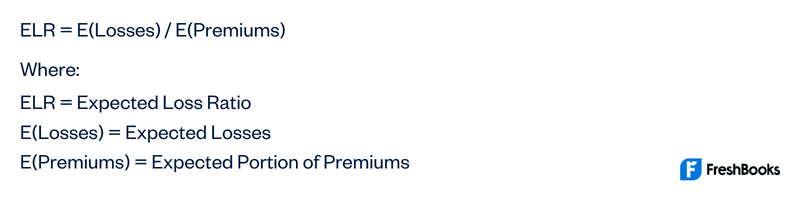
ELR method formula is:
How Do You Calculate Expected Loss Ratio?
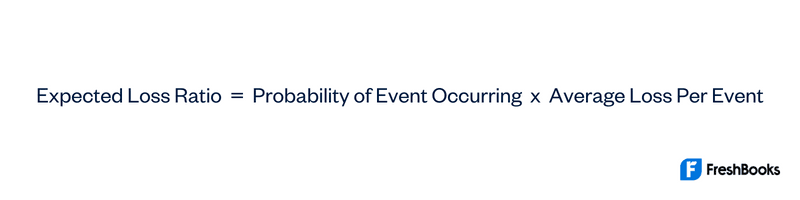
Another way you can calculate ELR method is by using the following formula:
For example, let’s say that you are considering investing in a new business venture. You could use the ELR method to calculate the expected loss ratio for this investment.
To do this, you would first need to determine the probability of the venture failing. You can do this by looking at historical data of similar ventures.
Next, you would need to calculate the average loss per event. You can do this by taking the total amount of money lost on failed ventures and dividing it by the number of ventures that have failed.
Once you have these two numbers, you can plug them into the ELR formula to calculate expected loss ratio for this investment.
ELR method is a useful tool for making decisions about investments and other opportunities. It is important to remember that this method is of statistical data and does not guarantee that an event will occur.
Expected Loss Ratio (ELR) Method Example
To illustrate how the ELR method works, let’s consider an example.
Suppose you are considering investing in a new business venture. You research the historical data of similar ventures and find that the probability of this venture failing is 20%.
You also calculate that the average loss per event is $100,000.
Plugging these numbers into the ELR formula, we get:
ELR = 0.20 x 100,000 = 20%
This means that the expected loss ratio for this investment is 20%. This means that for every $1 you invest, you can expect to lose $0.20.


Limitations of Using ELR Method
ELR method of calculating the cost of insurance is a very specific way of measuring the expense that the insurer has as a result of issuing policies.
It’s one way to measure how much money you spend on covering losses. But it’s also the only way that looks directly at costs rather than totaling them up and calling them expenses.
Because ELR looks at expected losses and expected premiums, it’s only useful for the period for which you have data. If you start out with low premiums and high expected losses, your ELR will be very low, and your insurance will be cheap.
If you start out with a high annual premium and low expected losses, your ELR will be very high, and your insurance will be expensive.
Although the ELR method can be a useful tool for making decisions, there are some limitations to using this method.
First, the ELR method is based on statistical data and does not guarantee that an event will occur.
Second, the ELR method only takes into account the probability of an event occurring. It does not consider other factors that could affect the outcome of an investment.
Third, the ELR method won’t consider the timing of events.
Fourth, the ELR method assumes that all investments are independent of each other. This assumption may not always be accurate.
Finally, the ELR method does not consider changes in market conditions over time.
Despite these limitations, the ELR method can still be a useful tool for making investment decisions.
Summary
ELR method is a statistical tool used to predict the probability of an event occurring. The method uses historical data to calculate the likelihood of an event happening again in the future. This data can help you make decisions about things like insurance premiums and claims.


FAQs about Expected Loss Ratio