Per Capita: Definition, Formula & Examples
Updated on February 24, 2023 | 4 min. read


🌟 KEY TAKEAWAYS

Per capita is an economic and statistical analysis term that directly translates to “by head” in English.u0026nbsp;
It is commonly used when comparing a certain metric to an entire population. Commonly this metric is economic in nature.u0026nbsp;
Common instances of per capita being used are for gross domestic product (GDP) and income.u0026nbsp;
Per capita information provides a more granular data set than aggregate information.u0026nbsp;
It is commonly used when directly comparing between countries with varying population sizes.u0026nbsp;
Per capita information is regularly contrasted with median information. Median provides a clearer picture because it considers outliers.u0026nbsp;
But what exactly does it mean? And what is it used for?
Read on as we take you through everything you need to know about per capita in our handy guide.
What Is Per Capita?
Per capita is a Latin phrase. It directly translates to “by head” in English. Per capita essentially means the average per person. It is often used in lieu of “per person” when talking about a statistical observance. In the business world, the phrase tends to be used in relation to economic or statistical data or reporting. But it can also be applied to pretty much any other thing where a portion of the population is mentioned.


How Does Per Capita Work?
The phrase per capita is mainly used in economics and statistics. It is used to determine how certain metrics apply to a certain population. The most commonly used instance of per capita is in reference to the metrics of a country. And how that metric then applies to the country's population.
Per capita is a common phrase in relation to the gross domestic product per capita, or GDP, and income per capita.
How To Calculate Per Capita
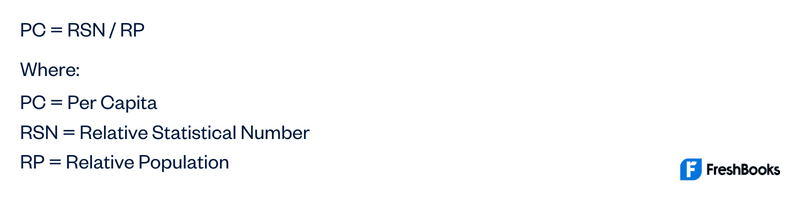
The formula that is used to calculate per capita is very straightforward. It can be written as follows:
What Is an Example of Per Capita?
For example, the US gross domestic product (GDP) in 2020 was $20.94 trillion USD. GDP is always measured in a dollar figure. The United States’ population at the same period of time was approximately 329.5 million people. So with this information, we can use the per capita formula to calculate the GDP per capita:
PC = 20.94 trillion / 329.5 million
PC = 63,543.58
So as we can see, the GDP per capita for the United States in 2020 was roughly $63,543.58 USD.
In an economic analysis, per capita is used as a direct comparison between countries. This is because all countries have different populations.
So for example, in 2020 China had the world's second-largest economy at $13.4 trillion USD, which is lower than the United States. However, at 1.402 billion, China is a far more populous country than the United States. So let’s use the formula again to figure out the per capita GDP for China.
PC = 13.4 trillion / 1.402 billion
PC = 10,500.40
So as we can see, the GDP per capita income for China is much lower as well - sitting at just $10,500.40 USD. So by using the per capita GDP, we can see that most citizens of China have a lesser income per person than the average American. This is despite the country’s aggregate output.


Advantages of Per Capita
Per capita helps to compare and analyze statistical data of different populations and different regions. It can be used to measure a nation's standard of living, as well as to ascertain its development.
It is advantageous in the fact that it gives you an accurate median measure of a particular population. It is also a measure that is very easy to understand. If there are 10 people in a room, 6 of which are men and 4 of which are women, then there is a 60% male population per capita.
Disadvantages of Per Capita
Although per capita is a widely used and popular measure, it does have some downsides.
For example, it doesn’t accurately provide a representation of the standard of living in a population. This is because the data can be skewed as it doesn’t account for income inequality. So for example, let’s say that 100 people are living in a village. 90 of them are earning $100,000 per year, and 10 of them are earning $10,000 per year, the per capita income is $89,000. This therefore doesn’t show a realistic picture of the income distribution among the village.
Here are some more issues that per capita doesn’t account well for:
- Inflation
- International comparisons
- Wealth and savings
- Factoring in children and the elderly
- Economic welfare
Summary
Per capita is a very useful metric to use for a variety of reasons. It can show important statistical data in any sector, from finance to social issues. However, the metric isn’t always useful or accurate when it comes to certain issues.
This is why any metric that uses per capita shouldn’t be instantly significant. Further research always has to be done before any major decisions are made. This is especially important when running a business. Any business decision should be based on a number of different metrics that cover as wide a variety of factors as possible.


FAQs on Per Capita