Vertical Analysis Definition, Overview & Examples
Updated on January 16, 2023 | 3 min. read


🌟 KEY TAKEAWAYS

Vertical analysis is a financial statement analysis method.
It analyzes financial statements by listing each individual item as a standard percentage.u0026nbsp;
Vertical analysis is more effective than horizontal analysis. However, it becomes more potent when working alongside horizontal analysis.
However, this can be countered by using a base figure for comparison. And then working out each transaction that is recorded in your financial books as a percentage of that figure.
This then allows you to conduct a vertical analysis.
But what exactly is a vertical analysis? And how can you convert your figures to allow for this method to take place?
Read on as we take you through the basics of vertical analysis.
What Is Vertical Analysis?
Vertical analysis is a method of analyzing financial statements. It works by listing each line item as a percentage of a base figure within the financial statements in question. Therefore, line items on an income statement can be listed as a percentage of the business’s gross sales. While line items on a company’s balance sheet can be listed as a percentage of total assets or liabilities.
This allows for vertical analysis of a cash flow statement. This shows each cash outflow or inflow as a percentage of the total cash inflows of the business.


Vertical Analysis Formula
The vertical analysis formula is a very easy-to-use, straightforward percentage formula. It is as follows:
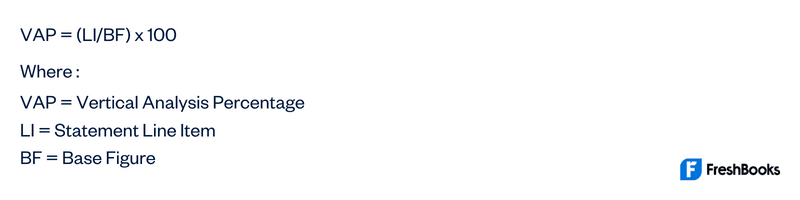
In order to use the vertical analysis equation, you need to figure out your base figure. On a business’s balance sheet, you can find the relevant base figure as the company’s total assets or liabilities. Though this is dependent on what you are attempting to measure as different financial documents will have different base figures.
How Vertical Analysis Works
Vertical analysis makes it much easier to read and compare the financial statements of one business to another. As well as across industries. This is because you can see the relative percentages in relation to the numbers as well as each other.
So instead of seeing base figures, you can see a percentage. Making it easier to compare a previous period of time series analysis. This is in order to get a clear picture of whether your performance metrics are improving or declining.
For example, if you see the various expense line items in the income statement as a percentage of sales. You can clearly see how these are contributing to your profit margins. It can also show you whether or not the profitability is improving over time.
Advantages of Vertical Analysis
There are a number of advantages when it comes to vertical analysis. Here are some of the key ones:
- Simplifies the correlation between single item lines on a balance sheet
- Can be used to set goals and threshold limits
- It is a more potent tool when compared to horizontal analysis
- Helps to compare a company’s statements to the average trends within the industry
- It is effective in comparing two or more different-sized companies operating in the same industry


Disadvantages of Vertical Analysis
There are still disadvantages to using a vertical analysis method. Let’s take a look at some of the key ones:
- It doesn’t help a company measure liquidity
- It does not provide a quality analysis of the financial statements due to the lack of consistency in the ratio of the elements
- It doesn’t follow accounting concepts and conventions
Example of Vertical Analysis
Let’s say that Company X has gross sales of $500,000 and a cost of goods sold (COGS) of $100,000. They also have a general and administrative expense cost of $200,000 along with a 25% tax rate. The income statement would look like this if they used vertical analysis:

Summary
Vertical analysis is a handy tool and a popular method for comparing financial statements. As well as the financial performance of companies. When using this alongside horizontal analysis, you can get a full picture of a company’s financial position.


FAQs About Vertical Analysis