What is Bad Debt? Meaning & Definition
Updated on April 26, 2023 | 2 min. read


🌟 KEY TAKEAWAYS

Bad debt is a business expense that occurs when expected customer payments becomes uncollectible
Once the accounts receivable is considered not collectible any more, the business would usually record it as a bad debt expense and reduce the accounts receivable balance by the same amount
Bad debts can be written off tax-wise on both your business and individual tax returns.
Whether you’re taking out debt to help build your capital structure, or you need the extra capital to survive. There are many reasons to take on debt.
However, debt can become uncontrollable or uncollectible, which is where bad debt comes into play.
Today, we’re going to take a look at what exactly bad debt is and how you can recognize it.
What Is Bad Debt?
Bad debt is an expense that a business incurs. This is once the repayment of previously extended credit, which is receivables from customers, becomes uncollectible. Once it cannot be collected, it is recorded as a charge-off.
Bad debt can include credit sales to customers, business loan guarantees, or loans to clients or suppliers.
Bad debt is part of the cost of business of extending credit to customers. Whenever a business extends credit to customers, they always have to take the risk that the payment won’t be collected. If a business takes on a large amount of bad debt, it can cripple the financial structure and strength of the business.When it comes to tax time, a bad debt credit can be written off on both your business and individual tax returns. Taxpayers must report bad debt deductions as well as credits, or refunds as a business expense.


Ways to Recognize Bad Debt Expenses
There are two different methods that are available to recognize a business’s bad debt expense:
● The direct write-off method
● The allowance method
Let’s take a look at both of these types of expense recognitions in more detail.
The Direct Bad Debt Write-off Method
The direct write-off method is when accounts are written off as soon as the business identifies that they are uncollectible. It is a regularly used method in the United States for income tax purposes. This method records the exact figures for the accounts that have been determined as uncollectible.


How Do You Calculate Bad Debts Using the Allowance Methods
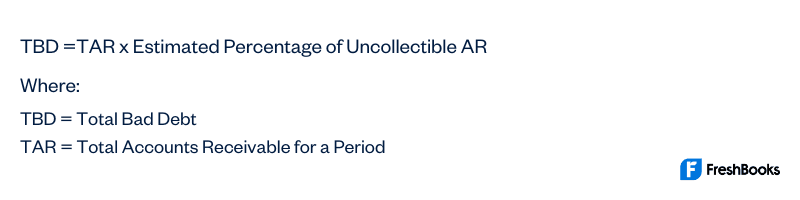
Bad debt can be calculated as follows:
How Do You Record Bad Debt
To record bad debts on your financial statements, you make a debit entry to a bad debt expense account. This is then offset by making a credit entry to a contra asset account. This account is also known as the allowance for doubtful accounts.
The contra asset account nets against the business’s total accounts receivable. This is shown on the balance sheet to reflect only the amount that is estimated to be collectible.
There may be a scenario where payments are received later for bad debts that have already been written off as uncollectible. These are then put into the book as bad debt recoveries.
Summary
Bad debt write-offs are one of the costs of doing business when you extend credit to customers. While it can be damaging to the financial health of your business, being prepared is the best way to deal with it. By putting aside capital in the event of bad debt occurring, you are not overstating your accounts receivables.


FAQs on Bad Debt
Say you’re running a wholesale business in the food industry. A restaurant has a monthly billing cycle with you where they collect goods throughout the month, then pay at the end of the month. Let’s say that the restaurant goes bankrupt, but they’ve already collected all of the goods which are now unreturnable. In this situation, the products/services have been delivered, but the amount the customer owed might not be collectible any more due to their bankruptcy. That amount the customer cannot pay back is considered as Bad Debt.
While bad debt is never a good thing, it’s important that you keep it manageable. A small amount of bad debt might be normal for running a business. But, if you find that more and more receivables are becoming uncollectible, it creates financial risks. For example, you might be short on cash to continue the production and operation.
Bad debt can be recovered if a piece of collateral is sold. This can be repossessing a car or a piece of real estate.
Good debt is debt that is used to further your business’ growth. Bad debt is uncollectible debt that becomes an expense for the business.