Liquidation Value Definition, Formula, and Example
Updated on February 23, 2023 | 4 min. read


🌟 KEY TAKEAWAYS

A company’s liquidation value is the net value of all of its physical assets. This is if they were to go out of business and have their assets sold.
It is a financial instrument used to simulate the worst-case scenario of a company going bankrupt and having to liquidate its assets.
It can also be used by a financially healthy company. For example when a company is considering a merger or applying for credit from investors.u0026nbsp;
It is calculated by subtracting liabilities from the value of assets.
Thousands of companies go out of business each year for a variety of reasons. Whether it’s because of a shift in the market, poor management, or just simply running out of money.
When a business owner decides to close the doors of their business, they will liquidate their business. That’s where liquidation value comes into play.
But what exactly is the liquidation value? And why is it so important to know?
In this article, we’ll take a closer look at the definition, formula, and an example of liquidation value.
What Is Liquidation Value?
A company’s liquidation value is the net value of all of its physical assets. This is if they were to go out of business and have their assets sold. When calculating a company’s liquidation value, intangible assets are excluded.
It is a financial instrument used to simulate the worst-case scenario of a company going bankrupt and having to liquidate its assets. It can also be used by a financially healthy company. For example when a company is considering a merger or applying for credit from investors.


The Liquidation Value Formula
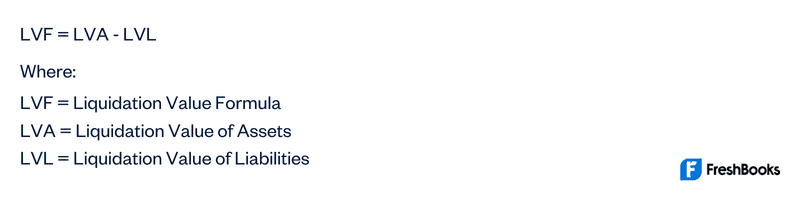
When looking at a company’s liquidation value, it can be worked out using the below formula.
Example of the Liquidation Value
Let’s say that Company X has a listed market capitalization of $50 million on the stock exchange. This company also has liabilities that they have reported which total $15 million. As well as a book value of $40 million. The appraiser has estimated the value of Company X’s assets at $38 million in the auction market.
By using the above formula, we can now work out Company X’s liquidation value.
LV = $38 million - $15 million
So:
LV = $23 million
This is found by taking the auction value of $38 million and subtracting the liabilities of $15 million.
The Three Types of Valuation
There are three different types of valuation used when liquidating a company:
- Book value
- Salvage value
- Market value
Let’s take a closer look at each type.


What Is Book Value?
As you can see in the example above, to figure out the liquidation value it's important to know the book value.
The book value of assets is the value of an asset in a company’s book of records. This is the value at any given time. It can be calculated as the original cost of the asset. But then minus the impairment costs and accumulated depreciation.
The Book Value Formula
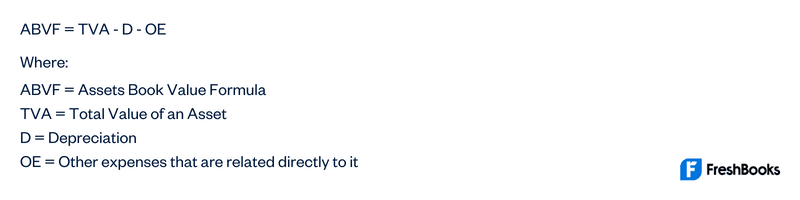
In order to figure out the book value, you have to follow the book value formula. This can be calculated as such:
Book Value Example
Let’s say that Company Y invested in a motor generator for $2,000 in 2017. If Company Y wanted to know the book value of this generator in 2022, then they would first have to figure out the depreciation.
$2,000 / 5 years = $400
If we then assume that there are no other costs involved for the generator, then we can use the book value formula to figure out the book value of the generator in 2022.
ABV = $2,000 - $400 - $0
So:
ABV = $1,600
This is the process that a company would have to do for all of their current assets when they are figuring out their liquidation value.
What Is Salvage Value?
When calculating the liquid value of a company, you also have to take the salvage value of assets into account.
The salvage value is the estimated value of an asset at the end of its useful life. So if a company is being liquidated and they have assets that can no longer be used for their original purpose, they would be valued as salvaged assets.
Salvage Value Formula
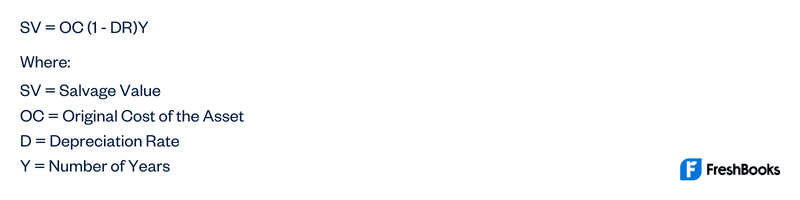
The formula used to calculate the salvage value of an asset is as follows:
Salvage Value Example
Let’s say that Company Z bought an asset worth $1 million. They calculated that the useful life of this asset would be around 20 years. The depreciation rate on which they would place on the asset was calculated to be 20%.
To figure out the salvage value of the asset at the end of the 20 years, we would use the salvage value formula:
SV = $1 million (1 - 0.20)20
So:
SV = $11,529.22
This would mean that the salvage value of the now useless item after 20 years would be $11,529.22.
What Is Market Value?
Market value can be defined as the price that a company’s asset would fetch in the marketplace. It can also be the value that investors give to a particular business or equity.
It is perhaps the simplest of the three as it requires no formula. It is merely the price that the marketplace puts upon the item. The market value is typically the highest valuation of an asset. But this can fluctuate depending on market demand.
Liquidation Value Assets
When calculating the liquidation value of a company, you have to figure out the value of its assets. There are two types of assets that a company may have.
- Tangible assets
- Intangible assets
Tangible Assets
Tangible assets are typically assets with a physical form that have a finite monetary value. They are normally the main form of assets for most companies across many industries. They are also the easiest to value and understand.
Examples of tangible assets include:
- Cash
- Inventory
- Vehicles
- Equipment
- Buildings
- Investments
Intangible assets
Intangible assets are not physical in nature and have a floating value. While there is no obvious physical value towards intangible assets, they do provide value for a business.
Examples of intangible assets include:
- Brand recognition
- Intellectual property
- Patents
- Trademarks
- Goodwill
- Computer software
- Licenses
Summary
Knowing your liquidation value is an important part of running your business. It shows you how much you can raise by shutting down your business but also conveys value to investors and creditors.


FAQs About Liquidation Value