How to Improve Cash Flow: 11 Tips Every Small Business Can Use
Updated on May 25, 2026 | 16 min. read



Unlock practical strategies to boost, track, and manage your small business cash flow year-round.
It’s the beginning of a new month. Your calendar’s packed, deadlines are piling up, and yet the numbers aren’t adding up. You notice that cash flow’s tight, leaving you to wonder: where did all that hard work go? When it comes to improving cash flow, you’re not alone.
Inflation’s been making headlines a lot these days—1.8% in Canada, 2.8% in the U.S at the time of writing this article. But it’s nothing new. Rising costs can sneak up on you at any time, and your cash flow is often the first thing impacted. Without healthy cash flow, it’s hard for any business to operate during those economic ups and downs. That’s where planning comes in.
In this guide, we’ll break down:
- What cash flow really means.
- How to track it effectively.
- Practical ways to boost your inflows, manage outflows, and make the most of tools like cash flow statements and forecasts.
🌟 KEY TAKEAWAYS

Improving cash flow isn’t just about selling more. Reducing expenses, optimizing payment terms, and smart inventory management are just as important.
Income and expenses both matter. Every dollar in and out impacts your cash flow, and accurate cash flow monitoring keeps your business prepared for changes and opportunities.
Stay proactive, not reactive. Make cash flow management a regular priority. Review your strategies often so you can spot issues and adapt before challenges arise.
What is cash flow?
Cash flow is the movement of money in a business. It’s the money that comes into a business and the money that leaves it. Positive cash flow (more money in than out) is what enables a company to continue operating.
- Cash inflows are the funds coming into your business. For example, daily sales.
- Cash outflows are the funds leaving your business. For example, operational expenses like rent.
Here are a few examples of what this can look like for your business:
Cash inflows (money coming in) | Cash outflows (money going out) |
|---|---|
Sales revenue, client payments | Rent, salaries/wages, invoices, utilities |
Investment income, grants, loans, lines of credit | Supplier payments, loan repayment, taxes |
Asset sales like equipment, vehicles, or renting out a space | Subscriptions, monthly fees, marketing fees |
Having adequate cash flow means bringing in more money than you’re spending. Or, in accounting speak, “more inflows than outflows.” This balance determines your overall cash position, which can either be positive or negative.
To find out whether your cash position is positive or negative, just run this simple equation—if the result is above zero, you have positive cash flow; if it’s below zero, it’s negative.
net cash flow = cash inflows – cash outflows
- Positive cash flow means your inflows exceed your outflows, your liquid assets are growing, and your business is making money.
Example: A freelance designer who earns $5,000 a month and spends $3,000 on software, taxes, and expenses has $2,000 in positive cash flow. - Negative cash flow means your outflows exceed inflows, indicating that your liquid assets are decreasing and your available cash is shrinking.
Example: That same designer might experience a negative cash flow during the summer when work slows down, but ongoing expenses like subscriptions, rent, and bills still add up.
Are negative cash flows a red flag? 🚩
Noticing a dip in your cash flow? It’s natural to worry about how it might affect your business. But a negative cash flow isn’t always a bad sign, especially if it’s temporary or expected.
Think of an ice cream shop in the winter. You don’t open your doors expecting to sell out of your award-winning mint chocolate chip when the temperature is colder than your deep freezer. Instead, you plan for the dip in sales and adjust your winter spending and summer promos accordingly.
That said, a consistent negative cash flow is a red flag. Managing your cash flow regularly—not just when you’re worried—can help you prevent this.
Why should improving your cash flow matter to you?
Ask any financial expert, and you’ll hear the same thing: A profitable business can still face insolvency if cash flow is mismanaged.
That’s because profit doesn’t automatically mean you can cover all of your obligations at the right time. Sometimes cash reserves run low, and that can make any business sweat.
If your business is seasonal or experiences seasonal fluctuations, you'll likely want to find ways to increase revenue during the peak season to help cover costs year-round. You may also look at strategies to reduce expenses during the off-season.
Regardless of the reason for improving cash flow, the underlying reason will always be the same: staying in business. And in order to do that, you need to bring in more money.
Types of cash flow
There isn’t just one type of cash flow. If you run a business, you’re likely dealing with the 3 main types—operating, investing, and financing—even if you didn’t know them by name.
Now’s the time to learn them, and more importantly, why they matter.
- More control. Understanding cash flow (including the different types) gives you control over your business’s finances. You see the full picture of your financial health so you can plan and act with confidence.
- Better strategy. Planning for your business’s future goes beyond looking at numbers. It means asking the right questions to help you know where you stand, how you got there, and how you’ll reach your goals. Even if that goal is simply to cover next month’s bills.
- Better decision-making. Knowing how cash moves in and out of your business helps keep your eyes open to any potential issues, so you can allocate resources more effectively and confidently plan for growth.
Take a look at the breakdown below to better understand the types of cash flow and their impact on your business.
Operating cash flow
This refers to the money moving in and out of your business from its core activities.
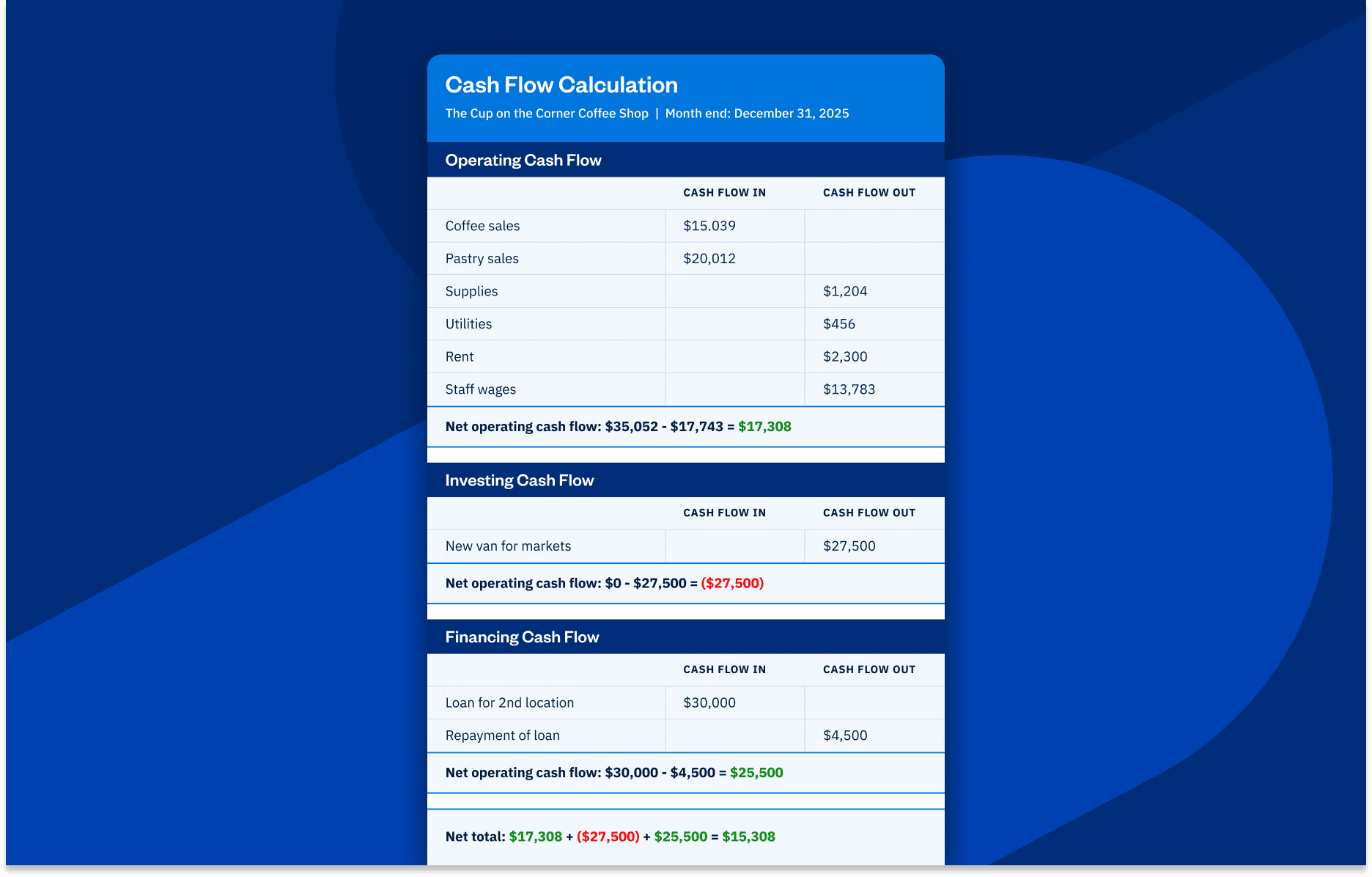
Example: The neighborhood coffee shop’s earnings from selling lattes and home-baked pastries while paying for ingredients, hourly wages, insurance, and utility bills. The cash coming in from sales, minus the cash going out for day-to-day expenses, equals operating cash flow.
Investing cash flow
This is the money a business spends or receives from buying and selling long-term assets, such as equipment, property, or vehicles.
Example: The coffee shop buys a vintage delivery truck to attend farmers’ markets across the province. This purchase is considered part of investing cash flow because it represents money spent on a long-term asset to help the business grow.
Financing cash flow
This refers to the amount of cash the company has generated or used in its financing activities.
Example: The same coffee shop takes out a loan to help finance another location and pay off a small existing debt. The money coming in from the loan and going out as a repayment is part of the shop’s financing cash flow.
Cash flow type | What it includes | Example | Why it matters |
|---|---|---|---|
Operating | Money from core business activities: sales, accounts receivable | Selling coffee; paying for ingredients, wages, insurance | Shows if daily operations generate enough cash |
Investing | Buying/selling long-term assets: equipment, property | Buying a delivery truck to expand the business |
|
Financing | Cash from loans, debt repayment, equity, dividends | Taking out a loan for a second location, repaying debt | Indicates how the business is funded and its debt |
6 ways to improve cash inflows
Improving cash flow doesn’t have to be complicated or time-consuming. Here are 6 ways to increase your cash flow and drive more sales while strengthening customer relationships.
1. Upsell, upsell, upsell
Most businesses underutilize one of their most valuable assets: their existing customer base, even when they have a loyal following. That’s where upselling comes in.
When upselling to existing customers, review their purchase history. Once you know their typical orders or information, reach out. Offer them services or goods that they’d be interested in alongside their usuals.
This does two things. First, it gets you a sale you may not have had. Second, it tells your customers that you’re paying attention. Which, in this economy, goes a very long way.
2. Increase your prices
Already have a customer base? Great. That means people are coming to you because they need your services. Consider this a sign to examine your pricing strategies. Providing your customers with a high-quality product should be your first priority. As long as you can do that, you can (usually) justify the cost.
Price increases are just one part of a larger strategy. Your marketing efforts should be based on the reasons that customers purchase your items. If you don’t clearly highlight why your product is worth the price it’s set at, it can adversely affect sales.
One of the strongest reasons to use this cash improvement strategy is that it doesn't affect operating costs. When you increase the price of a product you already sell, you aren’t creating an additional expense. This helps improve your cash flow right away, as long as the products continue to sell.
3. Sell in every possible way
When you’re trying to generate income, you need to be able to sell in every way possible. For brick-and-mortar stores, this means increasing online activity, including sales, engagement, and overall presence.
Most companies do significant business online these days, and some are online-only. So, if you haven’t set up online sales yet, you’re likely missing out on a key channel for revenue.
You can follow the same logic for online-only businesses that aren’t selling in person. They might be missing out.
To maintain healthy cash flow, sell your products wherever your customers are—online and in person. Expanding your reach helps you stay competitive and gives your business the best chance to thrive.
4. Convince customers to pay faster
If your business has unpaid invoices, you’re missing out on possible cash inflows. Managing accounts receivable is a key part of maintaining healthy cash flow. If you’ve sent invoices that have no response or struggle with late payments from clients, then it’s time to make paying more appealing.
You can do this in several ways, but one that always works? Discounts.
Offering early payment discounts to customers is a great way to make money quickly. Here’s how it works:
- When customers pay early (for example, within 10 days despite Net 30 payment terms), offer them a discount in return.
- It should be a slight discount. You never want to lose money. Finding the right balance between too much and not enough is difficult.
Once you’ve found the right amount, you’ll see cash coming in quickly. Who can turn down savings when everything else seems to be rising in price?
Other ways to encourage fast payments include:
- Offering a cash payment discount (no processing fees means money goes directly into your business’s pockets).
- Accepting electronic payments so clients can pay in one click.
- Setting up recurring payments that charge your client's credit card directly for regular services.
A tip for freelancers to get paid faster: Getting paid faster is one of the biggest cash flow challenges for freelancers. Beyond early payment discounts, freelancers can also include clear payment terms on every invoice, require deposits upfront for new clients, and use invoicing software like FreshBooks to send automatic payment reminders — so chasing payments takes less of your time.
5. Tend to your accounts receivable
Many businesses miss out on revenue by letting unpaid invoices pile up. Tapping into your accounts receivable is a proven way to boost cash flow. The money tied up in AR belongs in your bank account.
But the collections process isn’t always easy, especially when you want to preserve strong customer relationships. Staying on top of your AR ensures you get paid, and often, all it takes is a friendly reminder for customers to pay on time.
When you follow up with clients, it lets them know you’re paying attention—and they're reminded of what they owe. Sometimes that simple interaction is enough to increase business and incoming payments. Instead of handling reminders manually, consider setting up automatic payment reminders with your invoices in software like FreshBooks to make collecting what’s owed easier.
6. Sell off aging inventory
Inventory management isn’t always easy, leading to excess stock buildup. This might be from overordering or aging products. Regardless, it’s never helpful for your cash flow.
Too much inventory ties up cash and hurts your bottom line. Discount it strategically to free up funds while still earning a profit and moving products faster.
Set prices that will still yield a profit, but allow you to sell quickly. Most times, excess inventory is unnecessary, so selling it at a discounted price might just be the way to generate cash that you wouldn’t otherwise see.
5 ways to manage cash outflows
So far, we’ve focused on ways to increase cash inflows. Now, let’s look at the other side—reducing outflows. These tips can be just as effective for improving cash flow.
1. Lease, don’t buy
While owning things is appealing, it isn’t always the best strategy. Leasing can reduce your expenses and improve your cash flow if your lease terms are favorable.
Owning your assets is often more expensive in the short term due to upfront costs, especially if you finance a purchase or buy new. You have to pay much more when you own something. This is due to the associated costs of ownership. What’s more is that these assets tend to depreciate in value over time.
Some leases bundle certain costs like insurance, maintenance, and repairs into your payments, which can protect your cash on hand, too.
Leasing doesn’t build equity, but it can reduce your immediate costs.
2. Ask about discounts
If you’re considering offering discounts to your customers, it’s likely that your suppliers are as well.
But discounts aren’t always displayed for everyone to see. Sometimes, they’re reserved for customers who are aware of them or those who specifically request them.
If you have a good relationship with a supplier, ask them what they can do for you. The worst thing they’ll tell you is, “Unfortunately, nothing.” Hey, we’re all trying to save money, after all.
3. Evaluate your expenses
More often than not, businesses' expenses are too high. Evaluate costs regularly to determine where you're spending too much. It's one of the fastest and easiest ways to reduce costs and decrease your cash outflows.
Here are a few strategies:
- Review service terms. It’s common practice for service providers to raise rates for long-term clients, relying on complacency.
- Compare vendors. Take time to shop around and get competitive quotes for utilities or other services.
- Look for unnecessary expenses. Subscription creep is real. Check your accounts—you might be paying for services or products you no longer use, don't need, or simply forgot to cancel.
4. Buy in bulk
This might seem like a tactic that only works for large companies, but it isn’t. Small businesses should also consider purchasing their materials in bulk, as it’s one of the most effective ways to reduce expenses.
Large companies do it for a reason. Buying in bulk can reduce expenses over the long term, depending on how much you buy.
Unable to meet minimum purchase requirements? Find help. A partner, or several partners, to go in on bulk buys is a great way to reduce overall expenses. When you buy in bulk, the price per item is reduced. This means that even with shipping costs for a larger order, you’ll normally pay a fair amount less.
5. Look for ways to boost efficiency
Given the rise of AI and its impact on businesses and freelancers, you may already be using AI in your day-to-day to improve efficiency. And for good reason. When you run more efficiently, you spend less—cutting costs on labor, wasted materials, and time-consuming manual tasks.
For products, improving efficiency could mean streamlining production or using less expensive materials. For services, it often means automating repetitive work or optimizing processes, so you spend less on labor and overhead.
The effect of improving efficiency is compounding. It improves your bottom line as well as your cash flow. Think about it this way: The more efficient you become, the more products and services you can provide in a shorter amount of time. You spend less while making more.
Efficiency isn’t just for large corporations. For small businesses, simple moves toward efficiency can quickly reduce cash outflows.
How to understand and track your cash flow
When you’re running your business, understanding and keeping track of your cash flow is essential if you want to keep operating. It makes it clear where your money is coming from and where it’s going.
More strategies to help:
- Do regular bookkeeping to keep your financial records up to date.
- Use the right software that’s designed to support small business owners.
- Run cash flow statements and reports so you get a clear snapshot of your financial position.
- Using dashboards and alerts for a quick, real-time visualization of cash flow.
- Forecasting cash flow so you can proactively make informed decisions.
Maintaining a cash flow statement
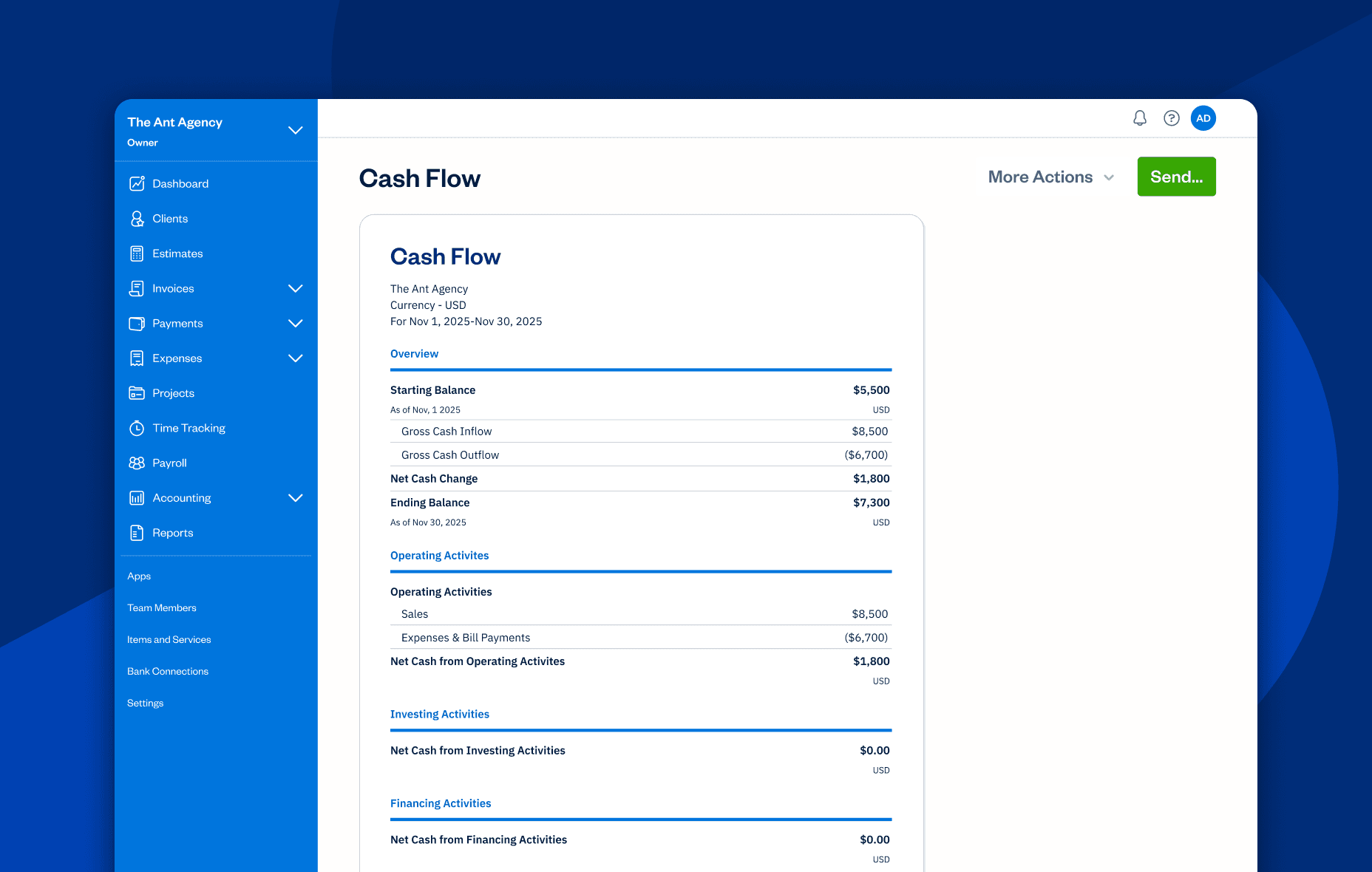
Your cash flow is tracked through a cash flow statement, one of the main financial statements alongside your income statement and balance sheet. This statement shows all the cash coming into your business (inflows) and all the cash going out (outflows) over a specific period of time.
Based on the 3 types of cash flow, statements are divided into 3 sections:
- Operating activities: Money generated or spent through your core business operations, like sales revenue, wages, and rent.
- Investing activities: Money used for long-term investments, like purchasing equipment or selling assets.
- Financing activities: Money related to borrowing, repaying loans, or owner investments.
How to forecast and track using cash flow ratios
Cash flow ratios are easy tools that help you understand the financial health of your business. Ultimately, they measure how well your business can meet its short-term obligations (like paying bills) using the cash and assets you already have.
Two of the most common ratios to track are called the current ratio and the quick ratio (acid-test ratio). Here’s how they work:
- Current ratio compares your current assets to your current liabilities (what you owe within the year). This allows you to determine if you have sufficient resources to cover upcoming expenses.
- What you’re looking for: A ratio above 1 generally means your business has more assets than liabilities, which is a good sign for your cash flow stability.
To calculate the current ratio, use this formula:
current ratio = current assets ÷ current liabilities
Then we’ve got the quick ratio—aka the acid-test ratio.
- The quick ratio is considered the conservative version of the current ratio. The formula excludes items such as inventory, focusing only on cash, receivables, and short-term investments. Essentially, assets that can be quickly converted to cash if needed.
- What you’re looking for: A quick ratio above 1 indicates that you can meet your immediate financial obligations without having to rely on selling inventory.
To calculate the quick ratio, use this formula:
quick ratio = (current assets – inventory) ÷ current liabilities
Example: Simple cash flow calculation
Think that calculating cash flow is a task best suited to the pros? Think again. Here’s an example of how to start putting together your own cash flow calculation.
And remember: The more proactive and organized you are with small-business tasks like expense management, revenue tracking, and forecasting, the easier and more accurate your cash flow statement will be.
5 ways to prepare a cash flow budget or forecast
Now that you know what a cash flow calculation looks like, the next step is learning how to plan ahead with a cash flow forecast. This will help you predict how much money will flow in and out of your business in the months ahead.
Here’s how to create one in 5 simple steps:
- Estimate your inflows: List all expected sources of income.
Pro tip: Look at your past months to spot trends or seasonal patterns, and adjust your plans and promotions for any upcoming changes. - Estimate your outflows: Outline all your expected expenses, variable costs (e.g., supplies or marketing), and one-time or annual expenses (e.g., equipment upgrades and taxes).
- Calculate net cash flow: Subtract your total outflows from your total inflows for each period. You’ll find out if your cash flow is positive or negative.
- Plan for gaps: Forecasting shows you where cash might run tight, letting you plan ahead. Think of it as preparing for a financial storm.
Pro tip: Notice that it’s harder to cover operational costs during a traditionally slow season? Get creative. Consider a promo to boost sales when people are already shopping or talk to your bank about a small loan to alleviate the financial strain. - Review and adjust regularly: Nothing in business is static, including your cash flow and forecasting for it. Compare your forecast to your actual cash flow each month to see if you’re on track or if new patterns are emerging. Those insights can inform your next forecast, helping you adjust and invest for growth and any cash bumps, dips, and jumps along the way.
Recap: cash flow management tips to keep your business on track
Improving cash flow matters for every business—even profitable ones. But it’s not just about earning more. Often, the smartest way to strengthen cash flow is to spend less and plan ahead.
Taking time to understand your cash flow statements and forecast the months ahead can make a major difference in your business’s financial health. When inflows slow, and spending continues, cash flow gets tight. That’s when expenses start to outweigh income. Forecasting, monitoring, and applying any of these 11 strategies can help keep your cash flow steady all year—not just when things feel strained.
Want to dive deeper into conquering cash flow? Download our e-book to learn more about what cash flow is and why it matters; how to keep track of it; how to manage income and expenses; and what to do if you find yourself in the red.
FAQs about improving cash flow