Limited-time offer: 80% off for 4 months + free onboarding support with FreshBooks.* Buy now & save
80% off for 4 months + free onboarding support*. Buy now & save


Balance sheet template
Download balance sheet template for free
Looking to improve your accounting process? Try our free balance sheet template! Download the template in seconds, and try FreshBooks for free for a complete accounting software solution.
What is a balance sheet?
A balance sheet is a financial statement used to obtain information about a company’s financial position as of a specific date. It’s an essential document for tracking your company's assets, liabilities, and shareholder equity, evaluating financial health, and supporting strategic, data-informed decision-making.
This document is used along with your income statement and cash flow statement to determine your business’s overall profitability. Unlike the income statement or the statement of cash flows, which provide financial information for a period of time (year, quarter, month), a balance sheet only provides a snapshot of your net assets at a specific time. It can’t provide information on long-term financial trends. Instead, it’s common to compare current period balance sheets to prior-year ones to track changes in your business assets, liabilities, and equity over time.
How do I create a balance sheet?
Creating a balance sheet can be a very simple process with the right tools. When you use the free downloadable template from FreshBooks, it can be broken down into 6 simple steps:
Choose a format
First, choose the P&L statement format that is most useful for you and your business’s needs.
Download the template
Next, download your free profit and loss statement template of choice in seconds from the FreshBooks website.
Enter revenue
You’ll be prompted to enter revenue information in the relevant field—keep your financial records on hand for this part.
Enter expenses
After entering revenue, you’ll input all relevant business operating expenses into the P&L report template.
Calculate net income
Simply subtract your business expenses from your business revenue to calculate your total net income.
Determine profitability
Finally, look at your bottom line. If your net income is positive, you’re profitable. If it’s negative, you’re currently unprofitable.
Download balance sheet template
The balance sheet templates from FreshBooks are customizable and simple to use. It’s easy to adapt these templates to your business’s specific needs. Downloading the template is completely free and takes moments—no login needed. You can also choose from several different formats depending on your accounting requirements.




Balance sheet format
What components are on a balance sheet? Let’s break it down:
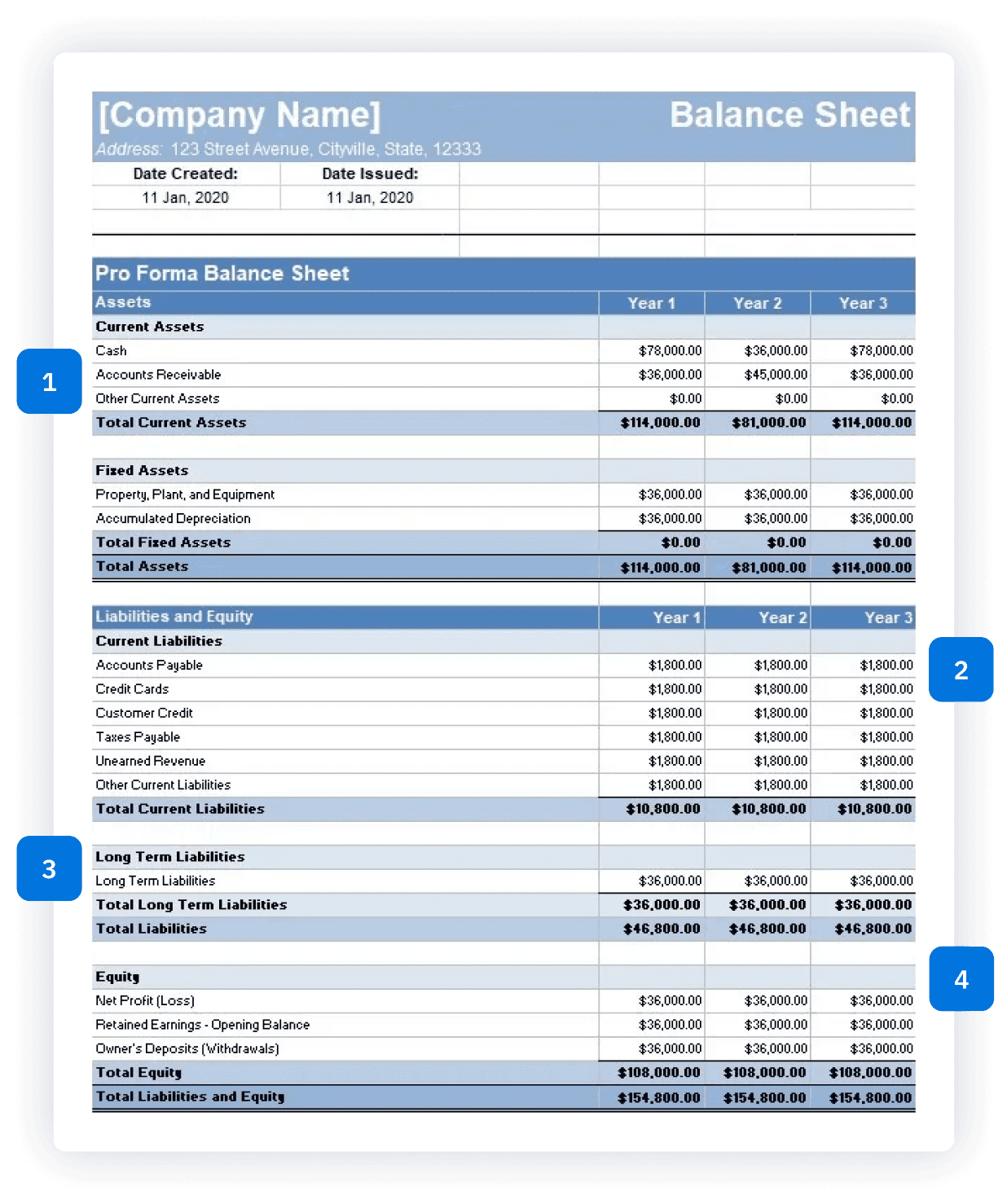
Balance sheet format
What components are on a balance sheet? Let’s break it down:
Revenue
Revenue (also called sales or income) refers to the money your business receives in exchange for goods or services you provide during a given time period.
Cost of goods sold
This section details your cost of goods sold, also called COGS. It includes expenses incurred for materials, labor, and overhead which directly contribute to the production of the goods your company sells.
Operating expenses
In this field, you enter any costs associated with running your business, such as cost of goods sold (COGS), property rental expenses, and other operating expenses.
Operating profit (loss)
Your profit/loss is your revenues minus your expenses. It will either be a positive number (indicating profitability for that period) or a negative number (indicating non-profitability).
Additional accounting templates
A balance sheet is one of the fundamental financial statements, but there are others your business will need to stay informed about your financial health. We offer a range of additional templates for financial statements, including:
Expense report template
This is a report containing categorized information on expenses incurred by the business, plus amounts, descriptions, and reimbursement details.
Expense report template
This is a report containing categorized information on expenses incurred by the business, plus amounts, descriptions, and reimbursement details.
Balance sheet template vs. FreshBooks accounting software
Our free balance sheet template is a great way to start streamlining your accounting process. But if you’re looking for a more complete time-saving solution, we recommend trying FreshBooks accounting software. It’s a great way to keep accurate financial records, quickly generate reports, and guide your business decisions. It has several other useful features, including:
| Features | Free Balance sheet templates | FreshBooks accounting software |
|---|---|---|
Mobile access |  | |
Pre-designed templates | | |
Downloadable templates | | |
Automated data entry |  Manual Entry Manual Entry | |
Automated calculations | Manual formula creation | |
Reduced error risk | | |
Cloud data storage | Limited | |
Automatic report generation | | |
Scalability | Difficult | |
Automatic recurring reports | | |
Sign up for a free FreshBooks trial today
Try It FreeHelpful resources for your business
Looking for even more handy tools to help you run your business? We offer several resources to help you improve your invoicing skills, expand your knowledge, properly separate personal and business finances, and make business decisions with confidence:
Balance Sheet: Definition, Components, and Example
Forecasting a Balance Sheet | The Small Business Guide to Financial Forecasts
How To Read A Balance Sheet: An Overview

Frequently Asked Questions
The basic balance sheet template format is the account format. This format has 2 columns, where assets are listed on the left side, and liabilities and equity (including retained earnings) are listed on the right side.
The basic formula of a balance sheet is Assets = Liabilities + Shareholders’ Equity. It’s a simple formula because your business must pay for all assets with either a loan (a type of liability) or with shareholder equity.
Assets are resources your company owns or controls to generate revenues and meet its financial obligations, such as cash and inventory, fixed assets (e.g., property and equipment), marketable securities, and money owed to you. Assets also include certain intangibles, such as patents, trademarks, and goodwill.
Liabilities refer to any money your business owes (is liable for) to external parties. These include loan amounts to be repaid, accounts payable, payroll expenses, and tax debts. On your balance sheet, liabilities are listed in the order in which they are due date (short-term to long-term).
Equity refers to the amount of money that would be paid to owners and shareholders if the company were to liquidate all of its assets (after paying all debts). In other words, equity is assets minus liabilities (net assets).
Your balance sheet shows the balance of your business’s assets, liabilities, and shareholder equity as of a specific date.
A balance sheet is 1 of 3 fundamental financial statements. The others are the profit and loss statement (also known as the income statement) and the cash flow statement. These 3 documents are the bare minimum for business accounting.
