Operating Cost: Definition, Formula & Example
Updated on January 13, 2023 | 4 min. read


🌟 KEY TAKEAWAYS

Operating costs encompass expenses in business for day-to-day transactions.
Costs of goods sold (COGS) and selling, general, and administrative (SGu0026amp;A) expenses are part of your operating costs.
Operating costs include necessary expenses like rent, utilities, payroll, and supplies.
Operating costs will appear on a company’s income statement.
- Cost of goods sold
- Administrative expenses like payroll
- Raw materials and supplies
- Manufacturing and storage costs
- Rent and utility costs
Operating costs do not include debt or investment-related expenses like financing and interest. You should calculate these items separately. To get your operating income, you subtract operating costs from revenue from the same period.
What Are Operating Costs?
Companies have operating expenses and non-operating expenses every month. You should calculate each set of expenses to evaluate how well your business is doing financially. Some costs are not directly related to generating revenue, but others are. Ideally, you use your operating cost calculations to make changes and run your business more efficiently.
Most businesses having an operating goal of maximizing profits. Strong revenue is always a good sign that the company is performing well. But, if operating costs are too high they can affect profitability. Lowering daily business expenses can increase profit margins without needing to increase sales. The cost of daily operations is inevitable, but many businesses can control spending by budgeting.
If you decide to cut operating expenses, first separate out your fixed costs. Things like rent, property taxes, and utilities are fixed costs. You cannot cut these expenses from your budget. Instead, focus on more flexible expenses that can vary from month to month.


Risks of Cutting Operating Costs
Of course, cutting operation costs too much can affect profits, too. Many operating costs boost productivity and without those day-to-day investments, your profit goes down. Business owners should be aware of the long-term effects of cutting operating costs. You may save money in the short term but then see a downward trend of profits in the long term.
Let's say your business cuts back on advertising for the coming quarter. You may see a higher profit margin because of the lower expenses at first. But in the next quarter, your profit margin lowers because you have less brand awareness. With some research and a commitment to improving, you can find a balance between operating expenses and revenue for your business.
Types of Operating Costs
Many business owners wonder what to include as operating costs for their business. If an expense is required for your overhead costs, it probably falls in this category.
Fixed Costs
Fixed business costs do not change over time with the ebb and flow of sales. Your company has to pay these expenses whether productivity is strong or not. These expenses do not affect your business's performance. This category of costs includes:
- Rent, including production facilities
- Repair costs
- Security
- Insurance
- Utilities
- Taxes
Variable Costs
Variable costs change with the sales and production cycles. If you have more demand for your product, you inevitably have a higher production cost. Some of these expenses can also change from month to month based on seasons, suppliers, etc. This category of costs includes:
- Production costs
- Office expenses
- Advertising costs
- Raw material
- Labor related to production
- Storage and shipping
Semi-variable Costs
These costs are also called semi-fixed or mixed costs. They may be fixed at a certain level. Once production reaches a higher threshold, these costs change. For example, salaries. They are fixed until your team needs to work overtime, at which point wages increase. Specific examples include:
- Maintenance costs
- Travel Expenses
- Inventory costs
- Personnel costs


How to Calculate Operating Costs
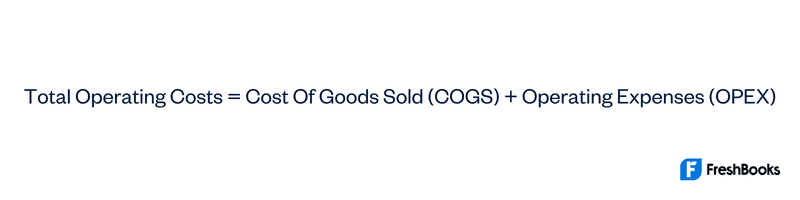
Your income statement should have these expenses itemized. You can add them up at the end of a given period to determine your operating costs.
The next step is determining your revenue for the same period. Once you have these two numbers, subtract operating costs from revenue to determine your operating profit. Ideally, your revenue is higher than your operating costs. If not, your business may not be profitable.
Real-World Example of Operating Costs
Let's use the cost formula to take a look at a baker's small business operations. The baker needs ingredients, tools, and product packaging for their operations. To complete 200 orders per month, the baker has a $1,000 estimation of operating costs. They have an average selling price of $45 for a bakery order. This equals around $9,000 in total revenue.
The baker's COGS is $1,000. They must also add in operating expenses like rent, utilities, internet, phone, and a business loan for $2,500. So, $1,000 + $2,500 = $3,500. The baker's net profit is $6,500. They still have to take a salary out of this amount, leaving the remaining balance to reinvest in the business.
It is important to remember that costs and revenue vary from month to month. Find the average annual operating cost by calculating each month individually. You should calculate other expenses like startup costs and marketing costs separately.
Summary
You can break down operating costs into three categories: fixed expenses, variable expenses, and semi-variable expenses. These business expenses represent the costs of daily operations. These costs are not tied to generating revenue. Still, operating costs contribute indirectly to business success. Cutting operating costs can save you money in the short term and cost you in the long term.


Frequently Asked Questions About Operating Costs