EBIT (Earnings Before Interest and Taxes): Definition & Formula
Updated on July 30, 2024 | 5 min. read


🌟 KEY TAKEAWAYS

EBIT measures a company's profitability and excludes interest and income tax expenses.
EBIT can be used to compare different companies within the same industry. It eliminates the impact of differing tax rates and capital structures.
EBIT can also be used to measure a company's operating profit. It excludes non-operating items such as interest expense and income tax expense.
Investors and analysts often use EBIT as a measure of a company's profitability and as a starting point for analyzing a company's financial statements.
Read on as we take a closer look at EBIT. We’ll take you through exactly what it is, the formula and calculation, an analysis of EBIT, and why it’s important to you and your business.
What Is Earnings Before Interest and Taxes (EBIT)?
EBIT stands for earnings before interest and taxes. It measures profitability while excluding financial and tax expenses.
EBIT can measure a company's financial performance and to compare it with other companies in its industry. It is also a component of some financial ratios, such as the EV/EBIT ratio.
EBIT is an important metric for investors. It shows how much profit a company makes from its operations before taking into account financing and tax expenses. This makes it a good metric for comparing the profitability of different companies.


Earnings Before Interest and Taxes (EBIT) Formula & Calculation
The EBIT formula is:
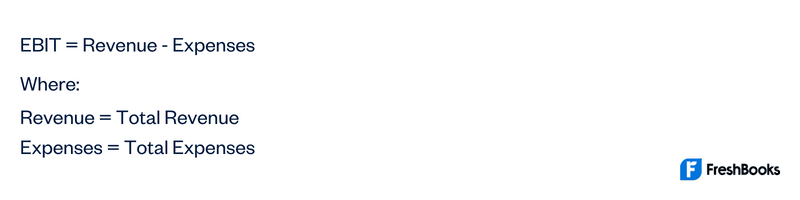
To calculate EBIT, simply subtract a company's total expenses from its total revenue.
For example, if a company has total revenue of $100 million and total expenses of $80 million, its EBIT would be $20 million.
EBIT can also be expressed as a percentage of revenue. This is known as the EBIT margin. To calculate the EBIT margin, divide EBIT by revenue and multiply by 100.
For example, if a company has an EBIT of $20 million and revenue of $100 million, its EBIT margin would be 20%.
EBIT Analysis
EBIT can assess a company's financial performance and compare it with other companies in its industry.
For example, if two companies have the same revenue, but one has a higher EBIT, this indicates that the first company is more profitable.
EBIT can also measure a company's profitability over time. If a company's EBIT is increasing, this means that it is becoming more profitable.
EBIT can also assess a company's ability to generate cash flow. This is because EBIT includes all income from operations, which is the cash that a company generates from its business activities.


Why Is EBIT Important?
EBIT is an important metric for investors. It shows how much profit a company makes from its operations before taking into account financing and tax expenses. This makes it a good metric for comparing the profitability of different companies.
For example, let's say a company's core operations provide good sales revenue. That company can fund ongoing improvements. This is reflected in the company's income statement.
And if the company also has good non-operating income, it will show a financial analysis worth investing in.
EBIT is also an important metric for analysts. It can assess a company's financial performance and compare it with other companies in its industry.
This gives them a guide to earnings and other key factors within a company. EBIT can also help analysts see strategic activities to offer guidance and direction.
Finally, EBIT is important for managers. It can measure a company's profitability and assess its ability to generate cash flow.
Suppose its ongoing operations provide good sales revenue. And there are minimal overhead expenses. Managers know the company analysis is strong. And if non-operating expenses are minimal, company performance is likely strong, as well.
Such performance for companies is vital to their success. EBIT allows mature companies to see where they stand internally. It's important to review the cash flow statement.
If there's negative cash flow, there are likely many issues that need to be addressed. But if there's positive cash flow, managers should have a pretty good idea of profitability.
Example of EBIT
Company A has total revenue of $100 million and total expenses of $80 million. This gives it an EBIT of $20 million.
Company B has total revenue of $200 million and total expenses of $150 million. This gives it an EBIT of $50 million.
Both companies have the same revenue, but Company B is more profitable because it has a higher EBIT.
Company A's EBIT margin is 20%, while Company B's EBIT margin is 25%. This means that Company B generates a higher percentage of profit from its revenue.
Company A's EBIT can assess its financial performance and compare it with other companies in its industry.
Company B's EBIT can assess its financial performance and compare it with other companies in its industry.
Both companies' EBITs can measure their profitability over time. If both companies' EBITs are increasing, this indicates that they are becoming more profitable.
EBIT vs EBITDA
EBIT and EBITDA are both measures of a company's profitability. However, EBITDA also includes depreciation and amortization expenses, while EBIT does not.
This means that EBITDA is a more comprehensive measure of profitability than EBIT.
But EBIT is still an important metric. It excludes financing and tax expenses, which can vary significantly from one company to another.
This makes it a good metric for comparing the profitability of different companies.
Advantages and Disadvantages of EBIT
Advantages of EBIT
EBIT is a simple and easy to understand metric.
However, EBIT does not include all expenses, such as financing and tax expenses. This means that it is not a comprehensive measure of profitability.
EBIT is a good metric for comparing the profitability of different companies.
EBIT can also measure a company's profitability over time.
EBIT is an important metric for investors. It shows how much profit a company makes from its operations before taking into account financing and tax expenses.
EBIT is also an important metric for analysts. It can assess a company's financial performance and compare it with other companies in its industry.
Finally, EBIT is important for managers. It can measure a company's profitability and assess its ability to generate cash flow.
Disadvantages of EBIT
EBIT does not include all expenses, such as financing and tax expenses. This means that it is not a comprehensive measure of profitability.
EBIT can be manipulated by management through accounting techniques such as creative accounting.
EBIT is a lagging indicator, which means that it does not show what is happening in the present or future.
Summary
EBIT is a profitability measurement that includes only earnings from its ongoing operations. This metric excludes items such as interest expense, taxes, and one-time items.
EBIT is often used as a proxy for a company's operating cash flow, which is the cash generated from its normal business operations.
EBIT can be a useful metric for comparing companies within the same industry, as it excludes items that can vary significantly from one company to another.


FAQs About EBIT