S Corp Payroll Guide: How It Works (Plus Pros and Cons)
Updated on September 21, 2026 | 10 min. read


S Corp status comes with a payroll requirement, even for a one-person business. Here's how to set your salary and pay yourself the right way.
So you made the leap to S Corporation status. It’s a smart tax-saving move, but in the excitement of filing that election, it’s easy to overlook the fact that you now have to run payroll, even if you’re a one-person operation with no other employees.
The IRS expects you to pay yourself reasonable compensation, meaning paying yourself a salary and withholding taxes. Get this wrong, and the tax savings that made S Corp status attractive can turn into an IRS audit, back taxes, and penalties.
In this guide, we break down S Corp payroll requirements and how to pay yourself correctly.
🌟 KEY TAKEAWAYS

The IRS requires you to run S Corp payroll if you actively work in the business.
Your S Corp reasonable salary must reflect the market value of your work; there’s no universally accepted percentage of profit, ratio, or formula.
S Corp payroll taxes apply only to your wages, not distributions.
What is an S Corp, and why does payroll work differently here?
An S Corp isn’t a separate business type like a limited liability company (LLC) or a C Corporation. It’s a tax election. You file Form 2553, Election by a Small Business Corporation, to elect S corporation status for an existing LLC or corporation.
As far as your state is concerned, you’re still an LLC or a corporation after you make that election. But you pay federal income taxes differently, and that’s where payroll enters the picture.
The IRS definition of an employee for FICA, FUTA, and federal income tax withholding purposes includes corporate officers. So once you elect S Corp status and work in the business, the IRS doesn’t see you as self-employed anymore. It sees you as an employee of your own company.
As a shareholder-employee, the business has to pay you reasonable compensation before you take distributions. Those wages run through payroll, just as they would for any other employee.
Structure | Ownership | Liability | Taxes |
|---|---|---|---|
Sole proprietorship | 1 person | Unlimited personal liability | Self-employment tax, individual income tax |
Partnership | 2 or more people | Unlimited personal liability unless structured as a limited partnership | Self-employment tax (except for limited partners), individual income tax |
LLC | 1 or more members | Owners are generally not personally liable for business debts or judgments | Self-employment tax, individual income tax |
C Corp | 1 or more shareholders | Owners are not personally liable for business debts or judgments | The corporation pays a corporate income tax; Individual shareholders pay FICA and income tax on salary and income tax on dividends |
S Corp | 1 or more shareholders (up to 100) | Owners are not personally liable for business debts or judgments | Business profits and losses pass through to the shareholder’s individual income tax return. Shareholders pay FICA and income tax on salary. |
How S Corp payroll works
As an S Corp shareholder-employee, the money you take out of the business comes in two separate buckets, and the IRS taxes each one differently.
Salary
- FICA (the Federal Insurance Contributions Act). These taxes fund Social Security and Medicare. FICA consists of 12.4% for Social Security and 2.9% for Medicare, split evenly between you and the business, for a combined 15.3%.
- Additional Medicare tax. The company must withhold 0.9% on any wages over $200,000, with no employer match.
- Income tax. The business withholds federal income tax based on how you fill out Form W-4. You may also have the company withhold state income tax.
Distributions
Any additional money you take from the business after paying yourself a reasonable salary is a distribution. Distributions don’t go through payroll and aren’t subject to withholding.
The tax treatment of distributions is the reason many business owners elect S corp status. While you still pay income taxes on 100% of your share of the business profits, you don’t pay FICA or self-employment tax on distributions.
At tax time, the S Corp files Form 1120-S and each shareholder receives a Schedule K-1. You use that K-1 to report your share of the business profits or losses on your individual tax return.
Do you need payroll if you're the only employee?
If you’re the sole shareholder in your S Corp and you actively work in the business, you need payroll, even if you never hire anyone else.
For example, say you run a graphic design studio and have no other employees. Because you work in the business, you’re a shareholder-employee and must pay yourself a reasonable salary, set up payroll, withhold taxes, and file payroll tax returns.
The rules change if you’re a passive shareholder. If you truly perform no services for the business and are just an investor, you can just take distributions.
What's a "reasonable salary," and how do you set it?
Unfortunately, the IRS doesn’t offer a dollar figure, fixed percentage, or formula for calculating “reasonable” compensation. Instead, it provides a list of factors that it weighs when deciding whether a shareholder’s compensation qualifies as reasonable. Those factors are:
- Training and experience.
- Duties and responsibilities.
- Time and effort devoted to the business.
- Dividend history.
- Payments to non-shareholder employees.
- Timing and manner of paying bonuses to key people.
- What comparable businesses pay for similar service.
- Compensation agreements.
In researching reasonable compensation, you might come across the idea that the IRS universally accepts a fixed split, like 60% salary and 40% distributions. But that’s not accurate. The IRS evaluates reasonable compensation based on the services you perform and the market rate for those services.
If the IRS asks you to defend your compensation, you’ll need records to back it up, such as:
- A written job description covering the duties you perform.
- Comparable salary data for your role, industry, and location.
- The hours you work in the business each week.
- Your training, credentials, and years of experience.
- How the business’s annual profitability factored into your salary decisions.
- Documentation of annual reviews or adjustments to your salary as your role or the business changes.
Pros and cons of S Corp payroll
S Corp payroll can lower your tax bill, but it also adds obligations you don’t have as a sole proprietor. Here’s a pros-and-cons list so you can consider both sides.
Pros
- Limits self-employment tax. Once you pay yourself a reasonable salary, any remaining profit paid out as distributions isn’t subject to FICA or self-employment tax.
- Personal liability protection. LLC or corporate status generally shields your personal assets from business debts and lawsuits.
- Avoids C corp double taxation. An S Corporation doesn’t pay federal income taxes at the corporate level. Business income and losses pass through to the shareholders’ personal income tax returns.
Cons
- Ongoing work and cost of payroll administration. You must run payroll on a set schedule, withhold and deposit federal and state payroll taxes, and file payroll tax returns each quarter. Using payroll software or a service can offset some of the tax savings.
- S Corps have annual filing requirements. S Corporations must file Form 1120-S each year and send a Schedule K-1 to each shareholder. That’s more complex than a sole proprietorship’s single Schedule C.
- The IRS can reclassify distributions as wages. If the IRS determines your salary isn’t reasonable, it can reclassify some or all of your distributions as wages. The reclassified amount is subject to FICA taxes, plus interest from the original due date.
Because of the added cost and complexity, it usually only makes sense to elect S Corp status when your business profit is well above what a reasonable salary would be for your work. That’s the range where taking part of your compensation as distributions saves you money.
How to set up and run S Corp payroll (step-by-step)
Setting up S Corp payroll comes down to a sequence of steps and filings. Here’s what it looks like from start to finish.
- Confirm or apply for an EIN. An S Corp needs its own federal Employer Identification Number (EIN), separate from your Social Security number (SSN). If you don’t already have one, apply for free online.
- Register with your state as an employer. Depending on your state, you may need a state income tax withholding account and a state unemployment insurance (SUI) account. You usually apply for these accounts through your state’s department of revenue and department of labor, but some states combine registration into a single portal.
- Set your reasonable salary. Work through the factors mentioned earlier and document your reasonable compensation decision.
- Choose a pay schedule and payroll system. Decide whether you’ll pay yourself weekly, biweekly, semimonthly, or monthly. Using payroll software is usually easier than calculating withholding manually.
- Complete your new-hire paperwork. Even though you’re the owner, you still fill out a Form W-4 for income tax withholding elections and a Form I-9 to verify your employment eligibility.
- Run payroll and deposit withheld taxes. Each pay period, withhold federal income tax, FICA, and any state income tax from your compensation. Deposit the withheld amounts, plus your employer share, on the deposit schedule assigned by the IRS.
- File Form 941 quarterly. This form reports the income tax, Social Security, and Medicare taxes. It’s due on the last day of the month following each quarter, so April 30, July 31, October 31, and January 31.
- File Form 940 annually. This form reports federal unemployment (FUTA) tax. It’s due January 31 for the prior year’s wages.
- Issue your W-2. Give yourself (and any other employees) a Form W-2 by January 31 of each year. This form reports total wages and withholding for the prior year.
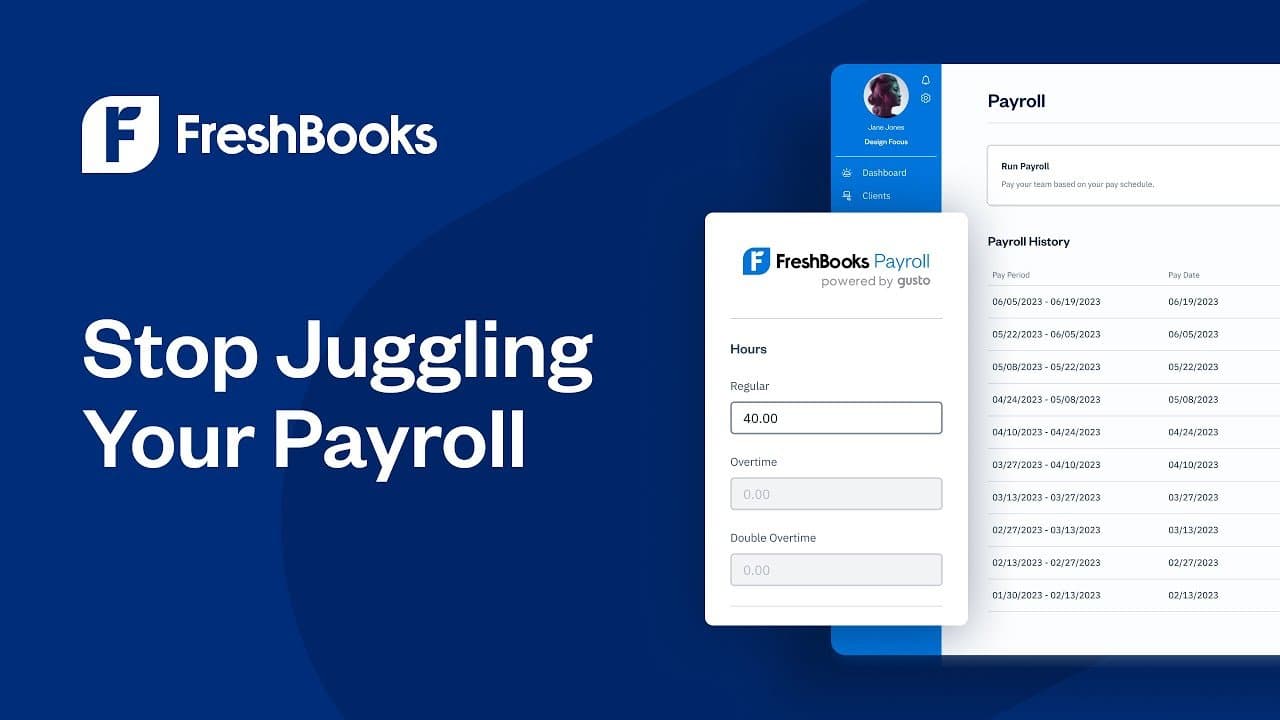
FreshBooks Payroll powered by Gusto can make this process a lot easier. It calculates and files your federal and state payroll taxes so you’re not manually calculating withholding, running payroll, and tracking deposit schedules on top of running your business.
Common S Corp payroll mistakes to avoid
A few common payroll problems can get S Corp owners in trouble, but they're easy to avoid if you know what to watch for.
Skipping payroll
Some owners take money out of the business as needed and call it all a distribution. But payroll isn’t optional if you’re an S Corp shareholder working in the business. S corporations without W-2 wages for the owner are a red flag to the IRS.
Paying a token salary and taking large distributions
The IRS watches for low salaries paired with high distributions. An unreasonably low salary can look worse than no salary at all, since it suggests you knew about the reasonable compensation rule and tried to work around it.
Paying yourself in one lump sum at year-end
Some business owners wait until December to see how profitable the year was, then issue themselves a single paycheck. But the IRS expects you to pay as you go, either via withholding or quarterly estimated payments. Run payroll on a regular schedule throughout the year, even if each paycheck is modest.
Setting your salary once and never revisiting it
What counted as reasonable compensation when your business earned $60,000 a year may not hold up once you’re bringing in $200,000 a year. Review your salary annually and adjust it when your role, hours, or business profits change.
Frequently Asked Questions (FAQ)
How do I pay myself from an S Corp?
Your pay from an S Corp comes from wages and distributions. Your wages run through payroll with tax withheld and must be “reasonable” based on the work you do. Distributions are a return on your investment in the business, and aren’t subject to FICA or self-employment taxes.
Does an S-Corp owner have to be on payroll?
Yes, an S Corp owner who actively works in the business must be on payroll. The IRS considers you an employee of your own company, and you’re entitled to compensation. The only exception is a passive shareholder who doesn’t work in the business.
Can an S-Corp owner take distributions without a salary?
No, not if you’re actively working in the business. Distributions aren’t a substitute for reasonable compensation. If you take distributions without a salary, the IRS may classify all or part of your distributions as wages.
What happens if my S Corp makes no money—do I still need to run payroll?
You generally don’t have to take wages if your S Corp is running at a loss, since there’s no reasonable compensation to pay yourself out of non-existent income. However, if you perform meaningful services for the business, consider paying yourself a reduced (but higher than zero) salary.
What is the 60/40 rule for S Corps?
The 60/40 rule refers to the idea that paying yourself 60% of profit as salary and 40% as distributions keeps you out of hot water with the IRS. But the IRS expects you to base your salary on the work you do and market norms, not an arbitrary ratio.